
White Oak Warrant Checks
White Oak offers no public name-search form for warrants. The Municipal Court page posts a fine-list image plus city contact details, and nothing there confirms a live warrant database. If a ticket or notice has your name on it, call the city court and ask whether a warrant issued.
- Check the citation for White Oak Municipal Court.
- Call the court using the current city contact page.
- Ask whether the file shows a capias, warrant, or FTA status.
- Confirm payment, appearance, and recall options before acting.
- Use a public-records request for a defined record or policy, not a personal status answer.
White Oak’s Public Search Is a Clerk Call
White Oak publishes no searchable warrant portal, so the practical warrant check is a phone call. The police FAQ points city-warrant questions to Municipal Court at 903-759-2061, and the public court page routes visitors through City Hall. Verify the current number and hours before you drive over, since the FAQ and county directory materials disagree on other office contacts. A written or online TPIA request can answer a narrow records question. It cannot tell you whether a warrant is active or what will recall it.
White Oak Police and Municipal Court
White Oak Police sits at 906 S. White Oak Road, White Oak, TX 75693, with a city main line of 903-759-3936. Municipal Court contact runs through City Hall. The official FAQ lists 903-759-2061 for city court matters. Check the current city page before trusting that number. The FAQ also notes that offenses above Class C move to Gregg County handling the next day. That matters, because a White Oak citation and a county case are not the same record.
White Oak Municipal Court
City Hall route
White Oak, Texas
903-759-2061 listed in city FAQ
White Oak’s Fine Image Is Not a Warrant Search
The Municipal Court page displays a public fine-list image, and it has no query fields. A fine schedule is not a warrant search. A name absent from that image proves nothing about whether the court issued process. For a city case, ask the clerk about the citation and its current status. A police report or fine list serves a different purpose than the court's warrant record. White Oak Municipal Court is the official source for both the image and court contact.
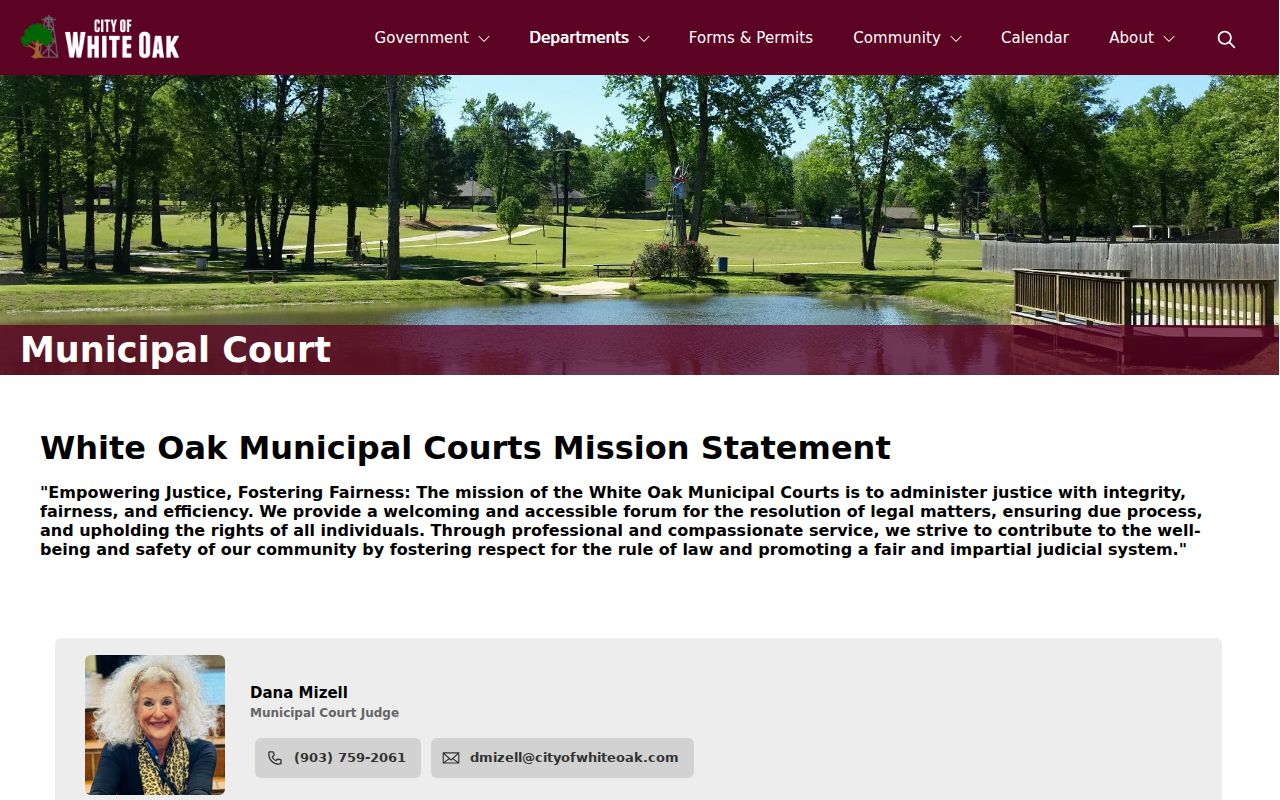
This image shows a court contact route, not an individual case result.
Warrants in White Oak: The Main Types
A city citation can ripen into an FTA status or a capias pro fine once a judgment goes unsatisfied. A criminal case can produce a separate arrest warrant. Matters above Class C may shift into county handling, as the local FAQ describes. The clerk can tell you which process sits in the White Oak file.
| City record | Possible event | First route |
|---|---|---|
| Traffic citation | Missed date or unresolved fine | White Oak Municipal Court |
| Capias pro fine | Judgment remains unpaid under its terms | Issuing court |
| Arrest warrant | Judicial process connected to a charge | Issuing court and authorized officer |
White Oak Warrant Files Can Move to County Court
The Police FAQ says offenses above Class C go to Gregg County the next day. That explains why a city contact may not hold every later case file. Ask whether White Oak Municipal Court issued the process or whether the case moved to a county court. White Oak City Jail shares space with the police department. Custody information and court case status are separate questions, so call the office that controls the exact matter.
White Oak Warrant Records: What They Show
White Oak's public pages show no sample warrant layout or searchable status fields. A clerk can pull the file with a citation or case number. Keep any public request free of unnecessary personal data.
| City / court | Identifies whether White Oak Municipal Court has the matter. |
|---|---|
| Citation | White Oak case number Use the identifier printed on the official notice. |
| Process | Ask whether the matter is an FTA, capias pro fine, or arrest warrant. |
| Fine list | Image on the court page; not confirmed as a warrant database. |
| Current status | Confirm with the clerk because no live search was located. |
White Oak Police Records Requests Are Separate
The city's open-records page takes written or online requests. Its police form asks for your name, address, email, phone, and the date, plus whether you want inspection or a copy and delivery by mail, email, fax, or pickup. Completed forms route to the Police Chief. The FAQ warns that a response may take ten business days. It also lists police-copy charges: requests under ten pages are free, ten or more pages run $0.10 per page, and a DVD costs $3. Those fees cover police records, not warrant searches. The White Oak open-records request page is the official route.
White Oak Warrants and Gregg County
White Oak Municipal Court controls its city citations; higher-level matters may flow into Gregg County court channels. The Sheriff's general directory lists 903-236-8400. White Oak's FAQ prints 903-236-8440 as a county warrant contact. That number also appears for the District Attorney. Verify routing against the current county directory. The county map is on Gregg County Warrant Records.
White Oak Warrant Phone Numbers Need Verification
The city FAQ's municipal court number and a county contact share one routing block. Use only the city-warrant line for a White Oak case. The county number conflict is a reason to check the sheriff directory instead of copying a stale FAQ. For city matters, ask the clerk about payment, a hearing, or recall. White Oak runs no amnesty or safe-appearance program.
Accessing White Oak Warrant Records
Texas public-information rules apply, though active law-enforcement, juvenile, confidential, and protected records can be withheld or reviewed. Chapter 15 Art. 15.26 covers copies of executed arrest warrants. It does not turn a fine-list image into a complete White Oak court search.
Ask for the right record: Use the Municipal Court for personal status and the city records route for a defined public document or policy.
White Oak Warrant Access Has Two City Channels
White Oak splits warrant questions into two channels. The city court answers citation and process questions, while the Police Department's TPIA request covers eligible police records. Pick the channel that matches what you actually need. Then ask what date range and record scope each source covers. A document request will not recall a court warrant. A clerk's status answer is not a police records search, so keep the fine list, the police file, and the court status separate from one another.